


Matthias Kaiser
MSc · CEO
Physicist and serial deeptech entrepreneur with over 15 years of experience in translating complex scientific innovation into commercial enterprise solutions.
Quantum-level accuracy with agent-driven execution for integrated drug discovery workflows
We reduce early-stage molecular uncertainty in drug discovery by bringing first-principles physics into therapeutic design. By combining quantum-ready simulation, high-accuracy computational chemistry, and AI with deep pharmaceutical expertise, we enable precise understanding and optimization of complex molecules, delivered through agentic systems and seamlessly integrated into existing pharma workflows to transform drug discovery from empirical trial-and-error into a predictive, engineering-driven discipline.
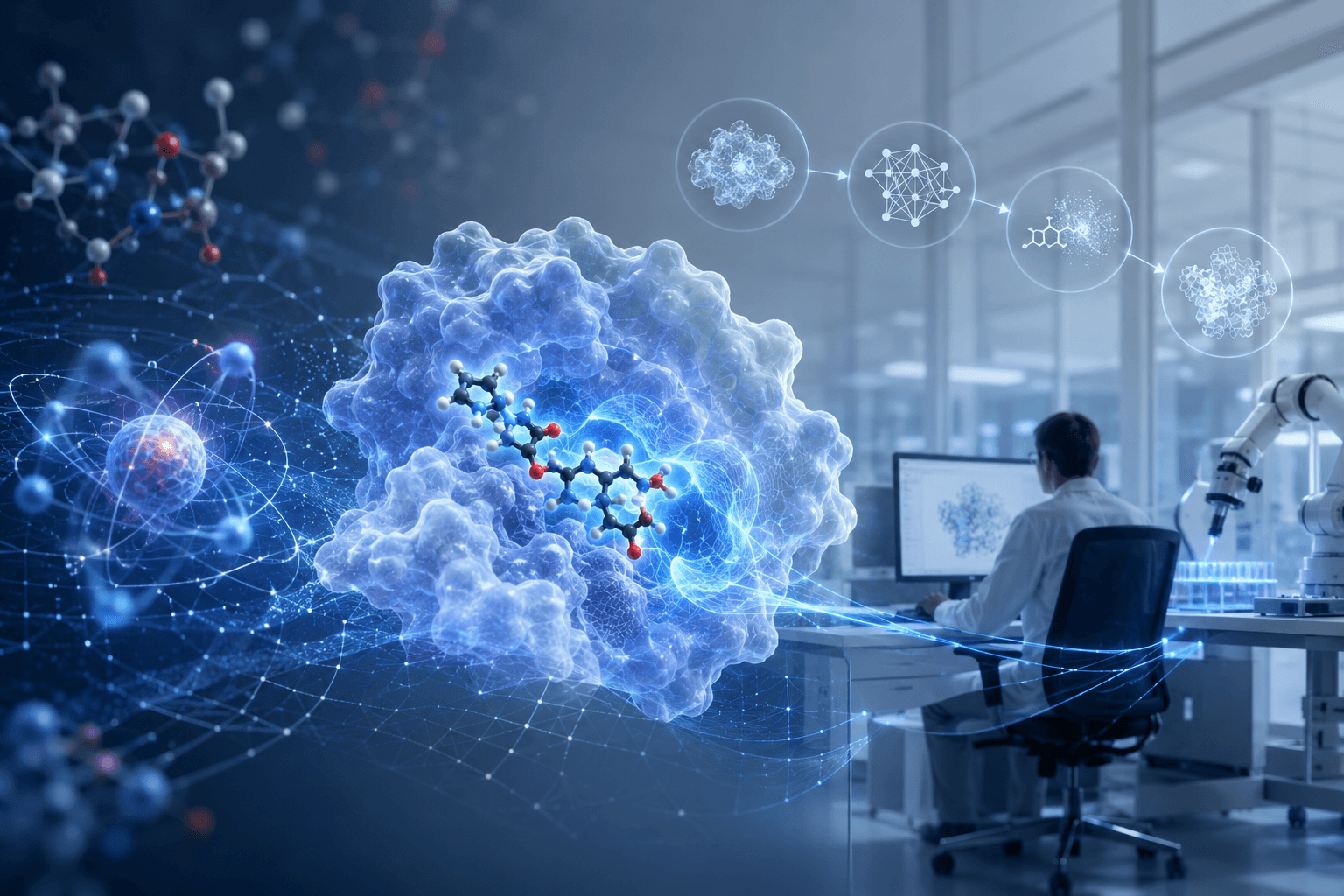
PexMachina brings first-principles physics into drug discovery, simulating molecules at the electron level to predict binding, stability, and conformational dynamics with true mechanistic accuracy.
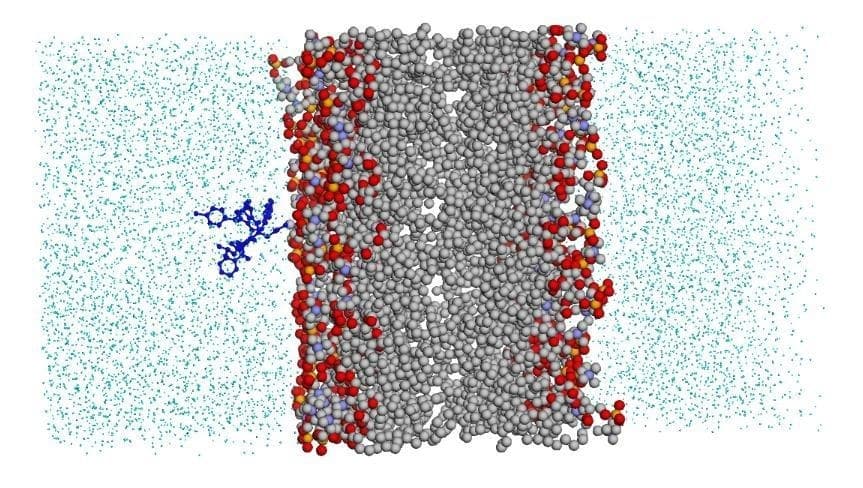
Our first application targets a major unsolved challenge: oral availability of peptides. We simulate how molecules behave across environments, such as water and lipid membranes, capturing conformational switching and polarity masking that determine whether a peptide can cross biological barriers.
But this is only the starting point. The same physics-based approach extends to binding affinity prediction, stability optimization, and the design of complex modalities like cyclic peptides and PDCs, integrated directly into real-world pharma workflows.
For the first time, key molecular properties can be designed, not guessed.
Drug discovery is slowed by fragmented software, specialized tools, and the complexity of translating scientific questions into computational workflows. PexMachina removes these barriers by allowing scientists to access molecular simulations through simple natural-language commands, transforming complex computational chemistry into seamless agentic workflows.
Delivered as an MCP service, PexAgent integrates directly into platforms such as Claude, Gemini, and other AI agents. Researchers can describe a problem in plain English, while PexAgent automatically selects, orchestrates, and executes the most appropriate simulation methods behind the scenes. Established industry-standard approaches handle routine molecular modeling tasks, while PexMachina's advanced tensor-network technology extends simulation capabilities to molecular systems that challenge conventional methods. The result is a single interface for both everyday simulations and the most demanding molecular design problems.
Organizations can further tailor PexAgent through customized workflows, automated decision pipelines, and dedicated user interfaces designed around their scientific and operational needs. Results are delivered in familiar formats such as SDF files, interactive 3D visualizations, and structured datasets that integrate seamlessly into existing R&D environments. Built to be quantum-ready from the ground up, the same workflows can scale from today's GPU infrastructure to future fault-tolerant quantum computers without rebuilding applications, retraining teams, or rewriting code.
Become an early user now and gain exclusive access to the PexAgent Early Access Program.
At PexMachina, we combine three traditionally separate domains into a single, powerful simulation stack: established molecular simulation workflows, high-precision quantum chemistry, and agent-driven interaction.
Our technology builds on proven computational chemistry methods and enhances them with first-principles, quantum-level simulations, running efficiently on classical infrastructure today and designed to scale seamlessly to quantum hardware. This enables a level of precision that captures the true physics governing molecular behavior, moving beyond approximations toward chemical accuracy.
What makes this truly practical is how it is delivered. Our agentic workflows orchestrate complex simulations, automate decision-making, and translate results into actionable insights. These agents can be integrated into any modern LLM system, allowing users to interact with advanced simulations through natural language, making high-end molecular modeling accessible without requiring deep technical expertise.
The result is a new generation of simulation workflows: precise, efficient, and seamlessly embedded into real-world drug discovery environments.
We leverage high-precision, quantum-computing-derived simulation methods to model molecular systems at a fundamentally deeper level than conventional approaches. By combining advanced electronic structure techniques with modern computational infrastructure, we achieve near–first-principles accuracy on today’s classical hardware, delivering meaningful results where it matters most.
Our technology is inherently quantum-ready. The underlying algorithms are designed to map directly onto fault-tolerant quantum computers as they become available. Today, this approach operates within defined system size limits, focusing computational power where precision is critical, such as in complex, high-value molecular regions.
As quantum hardware matures, these constraints expand naturally. Larger and more complex molecular systems can be treated with the same level of precision, without requiring a fundamental redesign of the methods or workflows.
This creates a seamless path forward: value today through high-accuracy simulation, and increasing advantage over time as quantum computing unlocks new computational regimes.

Physicist and serial deeptech entrepreneur with over 15 years of experience in translating complex scientific innovation into commercial enterprise solutions.

Over 25 years of experience leading scientific innovation at Merck, J&J, and Harvard.

A quantum theoretical physicist and former researcher specializing in quantum many-body systems and algorithm development.

Former R&D CIO at Johnson & Johnson and VP Engineering at Merck Research Laboratories, bringing decades of experience in scaling technology in pharma.

Over 30 years in peptide drug discovery, including as Director of the Peptide Laboratory at Massachusetts General Hospital, bridging what can be simulated with what can be built.